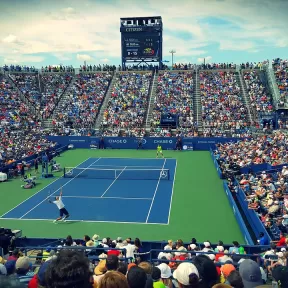
Mindset takes center court at Wimbledon 2025.
Key points
- 23 seeded players lost early, exposing holes in mental preparation while competing under pressure.
- Novak Djokovic and Carlos Alcaraz demonstrate elite mental toughness through illness and comeback wins.
- Coaches and analysts in player boxes now double as in-match psychological support.
Wimbledon 2025 is not unfolding like a predictable tournament, with shocking early exits, emotional reckonings, and standout mental strategies driving match outcomes. Here’s how players and their teams tackled the mental game to thrive.

Source: Pexels / Pixabay
When Mental Lapses Cost Top Seeds
This year’s entries brought a record-breaking 23 seeded players losing out in the first two rounds, eight of them being top-10 seeds. These early exits aren’t just about form or grass-court unfamiliarity; they underscore how fragile elite performance can be when psychological readiness is compromised. Research has long shown that cognitive fatigue and performance pressure impair fine motor skills and decision-making in tennis (Birrer & Morgan, 2010).
Among the most talked-about losses are:
- Coco Gauff (No. 2 seed): Just weeks after her Roland-Garros win, Gauff cited mental fatigue and the weight of overwhelming expectations. She double-faulted nine times and committed 29 unforced errors in a straight-sets loss to Dayana Yastremska.
- Jessica Pegula (No. 3): Upset by Elisabetta Cocciaretto, Pegula struggled with both tactical execution and mental edge. While she didn’t call it her worst match, she acknowledged that the Italian “just played too well.”
- Alexander Zverev (No. 3): After a grueling five-set loss, Zverev opened up about feeling “empty,” “alone,” and devoid of joy—internal battles no amount of technique could overcome.
Their performances spotlight what the research confirms: the mind isn’t just part of the game, it is the game.
Djokovic and Alcaraz Model Resilience
Some of the mental best came from players who stood firm amid points, illness, and pressure, showcasing exactly why mental toughness is a critical differentiator at the elite level (Cowden, 2016).
- Novak Djokovic battled a stomach bug during a grueling multi-set rally, yet leveraged resilience and unwavering focus to secure his 100th Wimbledon win. His ability to remain mentally engaged through physical discomfort remains a hallmark of his game.
- Carlos Alcaraz, despite dropping early sets to Fabio Fognini and Jan-Lennard Struff, managed to reset after mistakes and regain dominance by the Round of 16. His ability to regroup mid-match reflects pure mental strength under duress.
Both players offer textbook examples of elite-level psychological skills: emotional regulation, sustained attention, and the capacity to recover under pressure.

Source: StHugo / pixabay
Mental Performance Coaching in the Box
Mental performance professionals are no longer silent spectators: they’re now key strategists, helping players reframe setbacks, regulate arousal, and sharpen focus in real time. At this year’s Wimbledon, players leaned on psychologists, coaches, and performance analysts in their boxes to regain composure and make critical match-tactical shifts. Applied sport psychology interventions (e.g., attentional control, imagery, emotional regulation) can enhance in-match adaptability and resilience.
- Emma Raducanu relied on short-term coach Mark Petchey during her third-round duel with Aryna Sabalenka. Though she ultimately lost, Raducanu’s resurgence in consistency and confidence underscored the mental reinforcement a settled support team can provide.
- LTA Performance Analysts, like Toby West, offered real-time data paired with psychological framing to help British players interpret momentum shifts and adapt strategies under pressure.
From tactical recalibrations to emotional grounding, the team in the box is becoming a vital part of a player’s psychological toolkit at the highest level of the game.
Momentum Control and Reset Mindsets
Several players demonstrated the power of mental reset strategies to shift momentum mid-match, especially critical on grass, where quick points demand sharp focus and adaptability. The ability to pause, self-regulate, and adjust tactics in real time is a key differentiator on fast surfaces where mental momentum often matters more than physical endurance (Reid et al., 2016).
- Emma Navarro embodied this in her upset over defending champion Barbora Krejcikova. After losing the first set 2–6, Navarro recalibrated her tactics, shifted tempo, and maintained composure to clinch crucial points at pivotal moments.
- Research from the ITF shows that elite grass-court success hinges on winning short rallies (0–4 strokes), first-serve efficiency, and baseline consistency—requiring mental preparation that prioritizes staying present and executing high-percentage plays
Navarro’s performance, and others like it, highlight how mental skills like focused breathing, tactical awareness, and cognitive flexibility are just as essential as footwork and forehands when the momentum pendulum starts to swing.

Source: moerschy / pixabay
Bounce‑Back Mental Frameworks
For many players who regret early losses, bounce‑back is an active mindset plan:
- Zverev publicly acknowledged the need for deeper mental support: “Maybe for the first time… I’ll probably need a mental coach,” a moment of self‑awareness from a top player.
- Krejcikova, after bowing out early while nursing injury and fatigue, plans more strategic scheduling and recovery emphasis during the US swings to rebuild both physically and mentally.
Mental Game Lessons from Wimbledon 2025
Here’s what sports psychologists, coaches, and athletes can take from Wimbledon 2025:
- Early exits ≠ mental collapse, but transition strategies (e.g. clay-to-grass) and emotional recovery time are vital.
- Resilience flips outcomes: Djokovic and Alcaraz proved that how a player handles adversity often determines match momentum.
- Analysis and mental coaching in the box matter: from Petchey guiding confidence to performance analysts providing strategic calm.
- Reset and momentum management work: adaptability, short‑rally focus, and staying present turned matches around for Navarro and others.
- Bounce‑back plans are proactive: mental health support and planning beyond the match count almost as much as technical skills.
Wimbledon 2025 made it clear: you can have the biggest serves and tightest footwork, but if your head isn’t in the match, or you’re not using psychological support, big moments can humble even the top seeds.
References
Birrer, D., & Morgan, G. (2010). Psychological skills training as a way to enhance an athlete’s performance in high‐intensity sports. Scandinavian Journal of Medicine & Science in Sports, 20, 78-87.
Cowden, R. G. (2017). Mental toughness and success in sport: A review and prospect. The Open Sports Sciences Journal, 10(1).
Reid, M., Morgan, S., & Whiteside, D. (2016). Matchplay characteristics of Grand Slam tennis: Implications for training and conditioning. Journal of Sports Sciences, 34(19), 1791-1798.